GCN with PyTorch for Co-Purchase Recommendation
Collaborative filtering captures what users like; Graph Convolutional Networks (GCN) capture how items relate to each other. When two products are frequently bought together, that co-purchase signal is an edge in a graph. A GCN trained on that graph learns item embeddings that encode neighbourhood structure — items in the same buying context end up geometrically close. This article explains how GCNs work, then walks through a complete PyTorch Geometric implementation for item-to-item recommendation.
1. How GCNs Propagate Information
A GCN stacks layers that each perform one round of message passing: every node aggregates the feature vectors of its neighbours, transforms them with a learned weight matrix, and applies a non-linearity. After $L$ layers, each node’s representation encodes information from its $L$-hop neighbourhood.
The propagation rule for layer $l$ is:
$$H^{(l+1)} = \sigma!\left(\hat{A},H^{(l)},W^{(l)}\right)$$
where:
- $H^{(l)} \in \mathbb{R}^{n \times d}$ — node feature matrix at layer $l$
- $W^{(l)}$ — trainable weight matrix
- $\sigma$ — non-linear activation (ReLU)
- $\hat{A} = \tilde{D}^{-1/2}\tilde{A}\tilde{D}^{-1/2}$ — symmetrically normalised adjacency
$\tilde{A} = A + I$ adds self-loops so each node also retains its own features. $\tilde{D}$ is the diagonal degree matrix of $\tilde{A}$. The normalisation prevents the aggregated sum from growing with node degree.
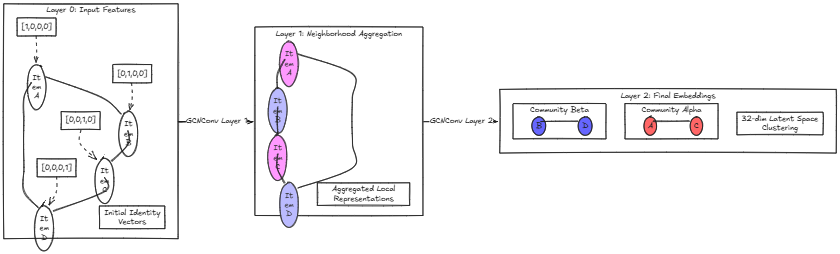 Figure: Two rounds of message passing turn raw item features into neighbourhood-aware embeddings.
2. Co-Purchase Graph Construction
Nodes are items. An undirected edge $(i, j)$ exists when items $i$ and $j$ appear together in at least one transaction. Initial node features are one-hot identity vectors — a neutral starting point that lets the GCN learn all structure from the graph topology.
import torch
import numpy as np
from torch_geometric.data import Data

np.random.seed(42)
torch.manual_seed(42)

N_ITEMS = 20  # toy catalogue of 20 items

# Simulate co-purchases: items in the same "category" (0–6, 7–13, 14–19)
# are bought together with probability 0.7; cross-category with 0.05.
edges = []
for i in range(N_ITEMS):
    for j in range(i + 1, N_ITEMS):
        same_cat = (i // 7) == (j // 7)
        if np.random.random() < (0.7 if same_cat else 0.05):
            edges.extend([[i, j], [j, i]])  # undirected → both directions

edge_index = torch.tensor(edges, dtype=torch.long).t().contiguous()
x = torch.eye(N_ITEMS, dtype=torch.float)  # one-hot node features

data = Data(x=x, edge_index=edge_index, num_nodes=N_ITEMS)
print(f"Nodes: {data.num_nodes} | Edges: {data.num_edges}")
3. GCN Encoder
A two-layer GCN maps the $N \times N$ identity matrix to $N \times 32$ embeddings. The first layer expands into a hidden space; the second projects to the final embedding dimension.
import torch.nn as nn
import torch.nn.functional as F
from torch_geometric.nn import GCNConv

class GCNEncoder(nn.Module):
    def __init__(self, in_channels: int, hidden: int, out_channels: int):
        super().__init__()
        self.conv1 = GCNConv(in_channels, hidden)
        self.conv2 = GCNConv(hidden, out_channels)

    def forward(self, x, edge_index):
        x = F.relu(self.conv1(x, edge_index))
        x = F.dropout(x, p=0.3, training=self.training)  # regularise
        return self.conv2(x, edge_index)

model = GCNEncoder(in_channels=N_ITEMS, hidden=64, out_channels=32)
4. Training with Link Prediction
The task is link prediction: the model should score real co-purchase pairs higher than random pairs. For each training step, negative_sampling draws item pairs that share no edge. The objective is binary cross-entropy on dot-product scores.
from torch_geometric.utils import negative_sampling

optimizer = torch.optim.Adam(model.parameters(), lr=0.01)

def bce_link_loss(z, pos_edge_index, neg_edge_index):
    pos_score = (z[pos_edge_index[0]] * z[pos_edge_index[1]]).sum(-1)
    neg_score = (z[neg_edge_index[0]] * z[neg_edge_index[1]]).sum(-1)
    scores = torch.cat([pos_score, neg_score])
    labels = torch.cat([
        torch.ones(pos_score.size(0)),
        torch.zeros(neg_score.size(0)),
    ])
    return F.binary_cross_entropy_with_logits(scores, labels)

model.train()
for epoch in range(1, 301):
    optimizer.zero_grad()
    z = model(data.x, data.edge_index)
    neg_edge = negative_sampling(
        edge_index=data.edge_index,
        num_nodes=N_ITEMS,
        num_neg_samples=data.edge_index.size(1),  # 1:1 positive/negative ratio
    )
    loss = bce_link_loss(z, data.edge_index, neg_edge)
    loss.backward()
    optimizer.step()
    if epoch % 100 == 0:
        print(f"Epoch {epoch:3d} | Loss: {loss.item():.4f}")
5. Generating Recommendations
After training, cosine similarity between embeddings drives recommendations. Known co-purchase neighbours are excluded to surface genuinely new suggestions.
model.eval()
with torch.no_grad():
    embeddings = model(data.x, data.edge_index)
    embeddings = F.normalize(embeddings, p=2, dim=-1)  # unit vectors → cosine = dot product

def recommend(item_id: int, embeddings, top_k: int = 5) -> list[int]:
    scores = embeddings @ embeddings[item_id]   # cosine similarity to all items
    scores[item_id] = -1                         # exclude self
    # Mask out existing co-purchase edges
    known = data.edge_index[1][data.edge_index[0] == item_id]
    scores[known] = -1
    return scores.topk(top_k).indices.tolist()

for anchor in [0, 7, 14]:
    recs = recommend(anchor, embeddings)
    print(f"Item {anchor:2d} → top-5 recommendations: {recs}")
Items 0, 7, and 14 are the respective category anchors. Correct recommendations should surface items from the same category (0–6, 7–13, 14–19).
Prerequisites
pip install torch torch_geometric numpy
PyTorch Geometric requires matching torch and CUDA versions. Follow the official installation guide if the default install fails.
Conclusion
A two-layer GCN turns a co-purchase graph into item embeddings that reflect buying context. The link prediction objective requires no user data — only item-item co-occurrence signals. This makes it a strong baseline for cold-start scenarios where user histories are sparse.
Directions for improvement:
- Richer node features: replace one-hot identity with product text embeddings (e.g., from a sentence transformer) to benefit categories with few co-purchase edges.
- LightGCN: remove activation functions and weight matrices entirely — the LightGCN paper shows this simplification improves recommendation quality by reducing overfitting.
- Temporal edges: weight edges by recency to discount old purchasing patterns.
For a different graph embedding approach applied to the same recommendation problem, see the article on Cleora graph embeddings.
The companion notebook with all the code from this article is available on GitHub.